Dr Goh became Singapore's first Finance Minister when the People's Action Party (PAP) won the general elections in 1959. When he discovered that the government was on the verge of going broke that year, he immediately and firmly introduced drastic measures to cut spending, including unpopular policies like cutting civil service salaries. At the end of the year, the government had achieved a small surplus of $1 million, instead of the $14 million budget deficit it hed expected. The PAP government has ever since followed Dr Goh's prudent nature, and always upheld budget discipline and fiscal prudence.
Next, Dr Goh began to jump-start Singapore's stagnant economy. He decided on a radical and untested strategy to industrialise Singapore rapidly, attracting foreign investments from multinational corporations (MNCs) to create jobs and exports. It was contrary to the conventional wisdom then, that developing countries could achieve economic growth through import substitution, and that MNCs were new colonial powers out to exploit poor workers in Third World countries. The Third World governments would impose taxes on imported goods, making locally produced goods more attractive to consumers. However, this had its disadvantages, such as lower productivity, price distortion and creation of local monopolies. Now, Singapore is one of the world's most open economies and its exports are more than double its GDP.
Important to the industrialisation programme was an enormous project to transform a 3,600ha of swampy area in Jurong into a modern industrial estate. Dr Goh saw this project as "an act of faith in the people of Singapore". He and his friend Mr Hon Sui Sen, then Chairman of the Economic Development Board, started to develop Jurong. This strategy did not work immediately. Investors were reluctant to set up their businesses there due to the instability and chaos created by the Communists and their sympathisers, especially after Singapore joined Malaysia, and the federal government in Kuala Lumpur controlled the award of Pioneer Certificates (for tax holidays) to investors. Not a single application for Pioneer Certificates was approved during this period. Therfore, Jurong made very little progress. The venture was nicknamed "Goh's Folly" by cynics.
However, after separation from Malaysia, these problems were solved. To create confidence in local investors and attract more foreign investors, Dr Goh made a big show of attending ground-breaking ceremonies and official openings for each factory, and getting TV coverage, Minister Mentor Lee Kuan Yew recalled in his memoirs. The much-needed jump-start for Jurong came when Dr Goh managed to persuade two Indonesian businessmen to set up the National Iron and Steel Mill. The industrialisation strategy proved worthy, and Jurong industrial estate took off. By 1968, almost 300 factories operated in Jurong, employing 21,000 workers. Today, the Jurong project has far outgrown its geographical boundaries. Jurong Town Corporation was renamed JTC Corporation, because it was managing industrial estates all over Singapore, not just in Jurong. JTC Corporation has also spun off commercial arms, like Ascendas and JTC International, which have planned and built industrial parks and townships in many Asian countries. These successes have won Singapore an international reputation as a first class infrastructure provider.
Dr Goh pioneered many other economic institutions. He helped form the Economic Development Board (EDB) in 1961 to kick-start Singapore's industrialisation programme. Its objective is to draw foreign companies to Singapore, by developing industrial promotion strategies and tax incentives, and serve as a one-stop agency for all their needs. The EDB grew so rapidly that Mr Hon Sui Sen, its first chairman, had to hive off different segments. The industrial estates segment was turned into Jurong Town Corporation while the development finance segment became the DBS Bank of today. In 2009, the EDB attracted $11.8 billion of investments and helped create 21,900 new jobs.
Dr Goh helped set up Jurong Shipyard, as he felt that in view of Singapore's strategic location, Japanese shipyards could be interested in establishing a shipyard here. In the early 1960s, he travelled to Japan to look for a large shipyard which was willing to cooperate with the Singapore Government in setting up a joint venture. He eventually managed to persuade Ishikawajima-Harima Heavy Industries Company of Japan to consider a joint venture, which paved the way for the establishment of Jurong Shipyard on April 25, 1963. Jurong Shipyard is now part of Sembcorp Marine group.
While being Minister of Defence, Dr Goh suggested that Sentosa be developed as a tourist attraction. Back then, the island was used mainly to house military units, and to train navy recruits. Dr Goh's suggestion took hold, and in 1968 plans were announced to develop the island into a holiday resort. The island's original name of Pulau Blakang Mati, which is Malay for "the island behind which lies death", was changed to Sentosa, which is Malay for "peace and tranquillity". Sentosa is now among Singapore's biggest tourist destinations, drawing more than six million visitors a year.
The Post Office Savings Bank (POSB) was established by the British in 1877 as part of the Straits Settlements' postal department. It flourished at first, but slowly declined. From 1957 to 1967, its deposits had plummeted to about $38 million. Dr Goh decided to make use of POSB to encourage a savings culture among Singaporeans, and to mobilise these savings for national projects, by creating a committee to revitalise POSB. Under the committee's recommendations, POSB created a savings competition for schools and launched new services and incentives. By the end of 1968, the bank's deposits was no longer declining. In 1972, the bank was made a statutory board under the Finance Ministry. POSB was acquired by DBS in 1998 and now boasts 3.5 million customers.
Dr Goh bought Singapore's first 100 tons of gold reserves, reserves, at US$40 per ounce, from then South African Finance Minister, Dr Nicolaas Diederichts, in a private exchange at the World Bank meeting in 1968. As of March 2010, Singapore had about US$212 million in official gold reserves, according to the MAS website. Gold price is currently nearly US$1,250 an ounce.
Dr Goh helped create the Monetary Authority of Singapore (MAS) in 1971, where he introduced policies that produced a stable Singapore Dollar and preserved the purchasing power of Singaporeanns. He firmly opposed allowing market players free rein to speculate on the Singapore dollar. MAS applied a very strict policy, famously known as "the non-internationalisation of the Singapore dollar". By the late 1990s, the restrictions were relaxed in incremental steps, in order to grow the fund management industry in Singapore. Under Dr Goh, Singapore implemented a unique monetary policy centred on exchange rate, instead of interest rate as in most other countries. The policy, still in use today, has brought about low inflation and high growth for Singapore.
However, instead of letting MAS take charge of issuing Singapore dollars, Dr Goh, who is an early proponent of a Singapore currency, insisted that a Currency Board should be kept separate. A currency board system is more troublesome to maintain as every single Singapore dollar has to be fully backed by reserves, but it also prevents the over-enthusiastic issuing of new dollar notes that could stroke inflation.
In the 1970s, the MAS invested the reserves from budget surpluses mainly in short-term assets that did not have the best returns. Dr Goh conceptualised the Government of Singapore Investment Corporation (GIC) to manage Singapore's foreign reserves in long-term investments, long before the term - sovereign wealth fund - was coined. He persuaded then-prime minister Mr Lee Kuan Yew to create it in 1981 and became its first deputy chairman. GIC has now grown into what analysts estimate to be the world's fourth largest sovereign fund, with a portfolio speculated to be worth more than US$200 billion.
Temasek Holdings was established in 1974 by Dr Goh to take over the management and ownership of 30 fledgling Singapore firms in which the government had co-invested, as Dr Goh believed that the government as policy-makers should distance itself from its role as shareholder in these companies. Temasek Holdings cultivated these start-up investments, and they grew into major corporate successes, including Singapore Airlines and SingTel.
Dr Goh also decided to close down all pig farms in Punggol, arguing that it was cheaper to import pork, given the cost of Singapore's land and pollution. The pig farmers were given about $50 million and they turned to farming orchids and ornamental fish. The last pig farm closed down in 1990.

Dr. Goh Keng Swee
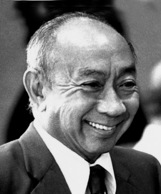
Singapore's Economic Architect
Search This Blog
Resources
- Tribute to the late Dr Goh Keng Swee by Ms Ho Peng, Director-General of Education
- Prime Minister Lee Hsien Loong's eulogy for Dr Goh Keng Swee
- What are Singaporeans suggesting?
- In Memory of Dr Goh Keng Swee
- The Architect of Singapore's Prosperity
- Dr Goh Keng Swee : His work his passion
- Complete Report - Dr Goh Keng Swee : The Passing of a Singapore Titan (St 15 May)
No comments:
Post a Comment